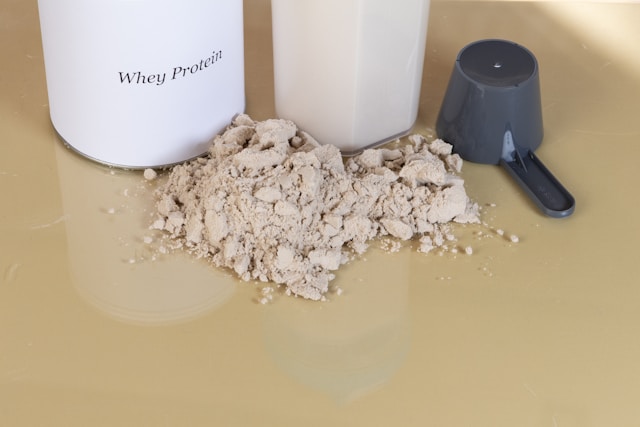
Collagen vs whey is not about which protein is “better.” It is about which tissue you are trying to support. Whey is better for muscle growth and muscle recovery. Collagen is better suited for skin, joints, tendons, ligaments, and connective tissue support.
Quick Take
- Whey is a complete protein. It contains all essential amino acids and is rich in leucine, which helps trigger muscle protein synthesis.
- Collagen is not a complete protein. It is low in essential amino acids and should not replace your main protein source.
- For building muscle, whey is the better choice.
- For skin, joints, tendons, and ligaments, collagen may be useful.
- For fat loss, whey usually has the edge because it supports fullness and muscle retention better.
- Many active adults can use both: whey for muscle, collagen for connective tissue.
The simple rule:
Choose whey when the goal is muscle.
Reach for collagen when the goal is connective-tissue support.
Collagen vs Whey: The Core Difference
Whey and collagen are both protein supplements, but they do different jobs.
Whey comes from milk. It is a complete protein, meaning it contains all nine essential amino acids. It is especially rich in leucine, which is one of the key amino acids involved in muscle protein synthesis.
Collagen comes from animal connective tissue. It is rich in glycine, proline, and hydroxyproline. These amino acids are important for connective tissues such as skin, tendons, ligaments, cartilage, and bone.
However, collagen is low in several essential amino acids.
That is why collagen should not be counted the same way as whey when your main goal is building or preserving muscle.
Think of it this way:
- Whey supports the engine: muscle.
- Collagen supports the frame: connective tissue.
Both can be useful.
They are not the same tool.
Which Builds Muscle Better?
Whey is the clear winner for muscle growth.
Muscle growth requires enough total protein, enough essential amino acids, and resistance training. Whey fits this job well because it is complete, high in leucine, and easy to use after training or between meals.
A randomized controlled trial in older women found that whey protein, but not collagen peptides, stimulated acute and longer-term muscle protein synthesis with and without resistance exercise: whey vs collagen muscle protein synthesis study.
That does not make collagen useless.
It means collagen is not the best supplement for muscle growth.
The International Society of Sports Nutrition recommends high-quality protein servings of about 20–40 g, depending on body size, age, and training stimulus: ISSN protein position stand.
Best choice for muscle
Choose whey if your goal is:
- Building muscle
- Preserving muscle during fat loss
- Recovering from strength training
- Increasing daily protein intake
- Supporting body recomposition
- Fighting age-related muscle loss
How to use whey
- Take 20–40 g when needed to hit your daily protein goal.
- Use it after training, at breakfast, or as a snack.
- Choose whey isolate if lactose bothers you.
- Use plant protein if you avoid dairy.
Whey timing is helpful, but total daily protein matters more than a perfect post-workout window.
What Collagen Does Better
Collagen is more useful for connective tissue support.
That includes:
- Skin
- Tendons
- Ligaments
- Cartilage
- Joints
- Bones
Collagen peptides may help with skin hydration and elasticity. A systematic review and meta-analysis of randomized controlled trials found that hydrolyzed collagen supplementation improved skin hydration and elasticity compared with placebo: collagen and skin meta-analysis.
Collagen may also support joint comfort and function in some people. A systematic review on collagen peptide supplementation found the strongest benefits around joint functionality and joint pain, although results vary by population and study design: collagen supplementation review.
Best choice for connective tissue
Choose collagen if your goal is:
- Joint comfort
- Tendon or ligament support
- Skin hydration and elasticity
- Support during high-impact training
- Extra connective-tissue support after 30
- A supplement that mixes easily into coffee or smoothies
How to use collagen
- Take 10–15 g collagen peptides daily.
- Pair with vitamin C or take it near a vitamin-C-rich meal.
- Use it consistently for at least 8–12 weeks.
- Do not use it as your main protein source.
Collagen is a targeted add-on.
It is not a replacement for whey, eggs, Greek yogurt, chicken, fish, soy, tofu, or other complete proteins.
Which Is Better for Fat Loss?
Whey usually has the edge for fat loss.
The reason is simple: whey is a complete protein that supports fullness and muscle retention.
During fat loss, your body needs a reason to keep muscle. Strength training gives the signal. High-quality protein provides the building blocks.
Collagen is lower in essential amino acids and less effective for muscle protein synthesis. It may still fit into a fat-loss diet, but it should not be your main protein.
Best choice for fat loss
Choose whey if you need help with:
- Higher protein intake
- Fullness
- Preserving lean mass
- Easy breakfast or snack protein
- Body recomposition
Choose collagen if you also want:
- Joint support
- Skin support
- Tendon support
A smart fat-loss stack might be:
- Whey or complete protein for daily protein
- Collagen for joints or skin
- Strength training
- Walking
- Sleep
- A moderate calorie deficit
For more on this, read BeeFit’s guide to Body Recomposition.
Can You Take Collagen and Whey Together?
Yes.
There is no problem combining them.
In fact, many active adults may benefit from using both because they cover different needs.
A simple combination:
- Whey protein for muscle
- Collagen peptides for connective tissue
You can take them together in one shake, but you do not have to.
Example
Post-workout:
- 1 scoop whey protein
- 1 scoop collagen peptides
- Berries
- Milk or water
- Optional oats or banana
This gives you complete protein from whey plus collagen peptides for connective tissue support.
However, do not let collagen replace the whey.
If you use both, think of collagen as the bonus, not the base.
How to Choose the Right Protein
Use this simple decision guide.
| Goal | Better Choice |
|---|---|
| Build muscle | Whey |
| Preserve muscle during fat loss | Whey |
| Post-workout recovery | Whey |
| Skin hydration and elasticity | Collagen |
| Joint or tendon support | Collagen |
| Higher daily protein | Whey |
| Dairy-free muscle protein | Soy, pea, or rice/pea blend |
| Complete aging-support stack | Whey + collagen |
Whey works best when
- Strength training is your priority.
- Muscle gain is the main goal.
- A calorie deficit makes muscle retention important.
- Daily protein targets are hard to reach with food alone.
- A complete protein is needed for recovery.
Collagen works best when
- Joint support is the main goal.
- Skin elasticity or hydration matters to you.
- Impact training puts stress on your tendons and ligaments.
- Tendon or ligament concerns are part of your training history.
- Complete protein intake is already covered elsewhere.
Using both works best when
- You are over 30 and train regularly.
- Muscle plus joint support matters.
- Fat loss is the goal, but training performance still matters.
- A simple recovery routine is easier to follow.
Common Mistakes
Mistake 1: Counting collagen as complete protein
Collagen contributes calories and amino acids, but it is not complete. Do not use it as your main protein source.
Mistake 2: Taking collagen after workouts instead of whey
For muscle recovery, whey or another complete protein is the better choice.
Mistake 3: Expecting whey to improve skin
Whey supports muscle and general protein intake. It does not have the same targeted connective-tissue role as collagen peptides.
Mistake 4: Ignoring total daily protein
One shake does not fix a low-protein diet. Your full day matters.
Mistake 5: Buying poor-quality supplements
Choose third-party tested products when possible, especially if you are an athlete.
Collagen vs Whey FAQ
Is collagen better than whey?
Not for muscle. Whey is better for muscle growth and recovery. Collagen is better suited for connective tissue, skin, joints, tendons, and ligaments.
Can collagen build muscle?
Collagen alone is not a good muscle-building protein because it is low in essential amino acids and leucine. Use whey or another complete protein for muscle.
Can I mix collagen and whey together?
Yes. Mixing them can be useful if you want muscle support from whey and connective-tissue support from collagen.
Is collagen good after a workout?
It can support connective tissue, but it is not the best post-workout protein for muscle. Use whey or a complete protein first.
Is whey good for skin?
Whey helps you meet total protein needs, but collagen has more targeted evidence for skin hydration and elasticity.
Which is better for weight loss?
Whey is usually better because it is complete, more muscle-supportive, and often more filling.
What if I am lactose intolerant?
Try whey isolate, which is lower in lactose, or use a complete plant protein such as soy isolate or a rice/pea blend.
Is there vegan collagen?
True collagen is animal-derived. Vegan “collagen builders” may contain vitamin C, amino acids, silica, or hyaluronic acid, but they are not collagen.
Bottom Line on Collagen vs Whey
Collagen vs whey is not a real rivalry.
They do different jobs.
Whey is the better choice for muscle, recovery, strength training, fat loss, and complete protein intake.
Collagen is the better choice for connective tissue, skin, joints, tendons, and ligaments.
Use whey as your main protein supplement.
Use collagen as a targeted add-on.
For many active adults, the smartest answer is not one or the other.
It is both, used for the right reason.
For a personalized nutrition and training plan based on your goals, protein needs, and workout schedule, try the BeeFit AI Calculator.
Related BeeFit Guides
- Collagen for Women
- Muscle Recovery Supplements
- Body Recomposition
- Strength Training After 40
- BeeFit AI Calculator
This article is for informational purposes only and is not medical advice. Supplements can interact with medications and may not be appropriate for everyone. Talk with a qualified healthcare professional before starting collagen, whey, or any supplement, especially if you are pregnant, nursing, managing kidney disease, treating a medical condition, or taking prescription medication.
Discover more from BeeFit: Fitness & Wellness
Subscribe to get the latest posts sent to your email.
Share :