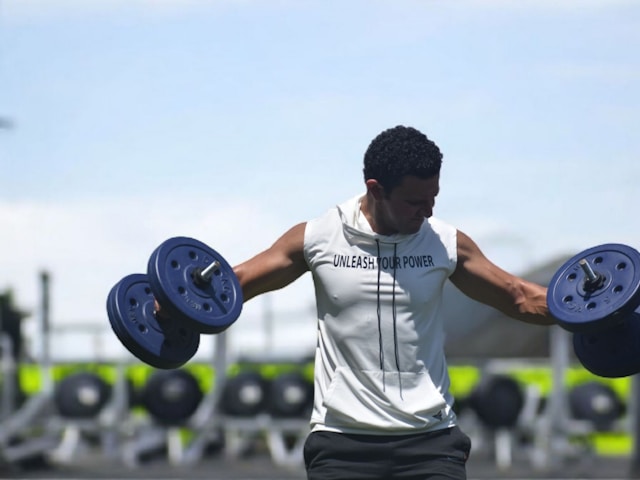
To build muscle without injury, you need more than effort. You need smart progressive overload, enough recovery, good exercise selection, and the discipline to train hard without letting your form fall apart.
Quick Take
- Progressive overload is essential, but it does not only mean adding weight every week.
- To build muscle without injury, progress through better reps, more control, more volume, improved range of motion, and smarter exercise rotation.
- Most people grow well by training each muscle group about twice per week instead of destroying it once per week.
- Exercise selection matters because some movements create more fatigue, soreness, and joint stress than others.
- Your recoverable volume changes with sleep, stress, age, nutrition, and life demands.
- The best long-term lifters balance objective progress with subjective feel, technique, and joint feedback.
The world of strength training is full of conflicting advice. Some people say you need to lift heavier every week. Others say you need more volume, more intensity, more soreness, or more advanced exercises.
The truth is simpler: muscle growth comes from repeated high-quality training that your body can recover from. If your plan constantly beats up your joints, ruins your form, or leaves you too sore to train consistently, it is not a smart muscle-building plan.
The goal is not to train softly; the goal is to build muscle without injury by progressing in a way your muscles, joints, tendons, and recovery system can actually handle.
1. Progressive Overload: How to Build Muscle Without Injury
Progressive overload is the single most important principle of strength training, but most people misunderstand it. You cannot simply add more weight or more reps to the same exercises indefinitely. That math does not work.
If you could add five pounds to a lift every month, in 10 years everyone would be lifting over 600 pounds on every exercise. This obviously does not happen. Chasing linear progress forever on the same few lifts often leads to stalled progress, form breakdown, and avoidable joint irritation.
That’s what people don’t talk about with progressive overload… you can’t just keep going up, it doesn’t happen. And then it’s frustrating when you think you have to progressively overload, and then you don’t get one more rep or you don’t get five more pounds… then you start contorting your form and you start getting joint pain and nagging injuries.
The solution is to think in cycles. Instead of trying to get stronger at everything all at once, dedicate a month to setting personal records on a specific movement pattern before switching focus. You might have a “squat month” followed by a “deadlift month.” To be clear, this does not mean you only do squats during a squat month. You always do all the movement patterns. It means the squat variation is the exercise you perform first in your workout, the one you are strategically focused on progressing, before moving to your other accessory movements. This variety allows for continuous progress over the long haul without the burnout of a more rigid approach.
For a deeper dive into this fundamental principle, check out this comprehensive guide on progressive overload training.
Your Application
Take one movement pattern this month and make it your focus. For squats, aim to add a small amount of weight or one extra rep each week. Next month, switch to a horizontal push like bench press. This cycling prevents plateaus and keeps your joints healthy.
2. Train Muscles Often Enough to Grow
Training a muscle only once per week can work, but many people do better with a more balanced approach that spreads weekly volume across two sessions. Modern science points to a more effective strategy centered on training each muscle group twice per week.
For many lifters, training a muscle group about twice per week is a practical sweet spot because it spreads volume across the week and reduces the need for one brutally long session. While training a muscle three times per week can be slightly more beneficial, it is significantly harder to recover from. The key is intelligent exercise selection. You cannot do three sets of walking lunges to failure on Monday and expect to have a productive leg session on Wednesday. They are too systemically taxing and create too much muscle damage. To train a muscle more frequently, you must choose exercises that are less demanding and don’t create as much soreness, like step-ups, hip thrusts, or certain machine movements.
Perhaps the most liberating principle for those buried under junk volume is this: you get the vast majority of your results from the very first effective work set. While subsequent sets add benefit, the returns diminish sharply. This science-backed insight shifts the focus from mindless volume to maximum quality and intensity on the sets that matter most.
Research has shown that training a muscle group twice per week produces similar or superior gains compared to training it once per week, even when total volume is equalized.
Your Application
If you currently train chest once per week with 20 total sets, split that into two sessions of 10 sets each, spaced three days apart. You will likely experience less soreness and better progress.
3. Choose Exercises That Spread Stress Across Your Body
For decades, glute training was one-dimensional, focusing almost exclusively on vertical movements like squats and deadlifts. Dr. Contreras revolutionized this with his “Rule of Thirds,” a framework for comprehensive glute development that targets the muscles from multiple angles and manages fatigue.
Explanation & Evidence
- One-Third Vertical Movements: These are the traditional heavy-hitters that work the glutes in the stretched position. They are highly effective but also the hardest to recover from. Examples include squats, lunges, deadlifts, and step-ups.
- One-Third Horizontal Movements: These exercises work the glutes in the shortened, or “squeeze,” position and are much less taxing on the body. Examples include hip thrusts, glute bridges, back extensions, and reverse hypers.
- One-Third Lateral/Rotary Movements: These exercises primarily target the glute medius and the upper fibers of the gluteus maximus. They are the easiest to recover from and include movements like hip abduction.
This framework is so effective because it develops all parts of the glute muscles, allows for higher overall training volume by mixing hard exercises with easier ones, and ultimately prevents the recovery deficits that can stall progress.
For a full breakdown of this method, visit Dr. Contreras’s own guide on the Rule of Thirds for glute training.
Your Application
Audit your next leg day. Are you doing only squats and deadlifts? Add hip thrusts for horizontal work and cable abductions for lateral work. This balanced approach will build a more complete, athletic physique.
4. Match Exercise Selection to Your Goal
Yes, exercise selection can shift emphasis. If your goal is more glute focus with less quad fatigue, use more hip-dominant movements and fewer high-volume squat or lunge variations.
The prescription is straightforward: minimize or completely cut out the vertical movements that heavily target the legs, such as squats and lunges. Instead, focus your efforts on exercises that isolate the glutes more directly.
Your go-to exercises for this goal:
- Hip Thrusts
- Kickbacks
- 45-Degree Hyperextensions
- Abduction movements
Dr. Contreras adds an important caveat: many women think they do not want leg growth because of existing body fat on their thighs. However, once they lean out and build muscle, they often change their minds and appreciate the strong, athletic look of their legs.
This approach works because it emphasizes hip extension over knee extension, directly targeting the glutes while minimizing quad involvement.
Your Application
For one training cycle, replace your back squats with hip thrusts as your primary lower body movement. Pair this with kickbacks and abductions. You will likely feel your glutes working harder and your quads recovering faster.
5. Recovery Rules to Build Muscle Without Injury
One of the most critical concepts for long-term success is not a specific exercise or rep scheme but a personal philosophy: understanding your Maximum Recoverable Volume. This is the maximum amount of training you can perform while still being able to properly recover, adapt, and get stronger.
Crucially, MRV is dynamic, not static. It is highly personal and changes based on genetics, stress levels, sleep quality, and age. Your MRV on a week with great sleep and low stress is higher than on a week with a major work deadline and poor sleep. The expert lifter does not follow the plan blindly. They autoregulate, adjusting the plan to their current capacity.
This connects directly to psychology. Training at a sustainable frequency where you feel excited to go to the gym (e.g., 2-3 times per week) will produce far better results than dreading an unsustainable 5-6 day schedule that constantly pushes you past your MRV.
The Renaissance Periodization team defines MRV as your upper limit before recovery fails and gains stop.
Your Application
Keep a simple log. Rate your energy, sleep, and motivation daily. If you consistently feel run down, reduce your total sets per muscle group by 20-30% for a week. This is not weakness. It is autoregulation: adjusting training so recovery can catch up and progress can continue.
Learning to build muscle without injury also means knowing when to push harder and when to reduce volume before soreness turns into pain.
6. Balance Numbers, Form, and Muscle Feel
Dr. Contreras outlines two essential and sometimes competing philosophies that drive muscle growth. Mastering the balance between them is the key to lifelong progress.
Explanation & Evidence
- The External (Quantity): This is the objective, numbers-driven approach. It is about focusing on your logbook and striving to lift more weight or perform more reps over time.
- The Internal (Quality): This is the subjective approach focused on the mind-muscle connection, perfect form, and making the final reps of a set feel as hard as possible through intense focus.
Relying only on the external is how lifters chase numbers with deteriorating form, leading to a “nagging injury cycle.” Conversely, relying only on the internal can lead to stagnation, as your mind will often quit before your muscles truly need to.
That’s why you’ve got to have this yin and yang—the external and the internal. Progressive overload with the mind-muscle connection… those two are the yin and yang that keep each other in check, and those two pathways are necessary to optimize hypertrophy over the long run.
A study comparing training frequencies found that training a muscle group twice per week produced similar increases in strength and size compared to three times per week, with effect sizes favoring the twice-per-week group.
Your Application
During your heavy compound lifts, focus on the external goal of adding weight. During your accessory isolation lifts, drop the weight and focus purely on feeling the target muscle work. This hybrid approach gives you the best of both worlds.
Build Muscle Without Injury FAQ
These answers cover the most common questions about how to build muscle without injury while still training hard enough to grow.
Q: How many times per week should I train each muscle group for optimal growth?
A: Research suggests that training each muscle group twice per week is superior to once per week for muscle growth, even when total weekly volume is equalized. Three times per week can be slightly better but is harder to recover from. For most people, twice per week is the “sweet spot.”
Q: Is it better to train to failure on every set?
A: No. Training to failure on every set can dramatically increase fatigue without providing much additional growth stimulus. It is best reserved for the final set of an exercise or for isolation movements. Leave 1-2 reps in the tank on your heavy compound lifts.
Q: Can I build muscle without gaining fat?
A: Yes, through a process called “body recomposition.” This requires a slight calorie surplus (or maintenance) with high protein intake and consistent, intense resistance training. It is slower than traditional bulking but allows for leaner gains.
Q: How long should I rest between sets for muscle growth?
A: For hypertrophy, rest periods of 2-3 minutes are optimal. This allows for sufficient recovery to maintain performance across sets without cooling down too much. For heavier strength work, rest 3-5 minutes. For metabolic conditioning, rest 30-60 seconds.
Bottom Line: Build Muscle Without Injury for the Long Run
Successful, lifelong resistance training is an intelligent pursuit, not just an act of brute force. By applying principles like strategic exercise variety, managing your recovery with your personal MRV compass, and balancing objective goals with internal focus, you can build an impressive physique while avoiding the plateaus and injuries that sideline so many.
It is about shifting your perspective from the short-term to the long-term. Instead of asking “how much can I lift today?”, what if the better question is “what training choices can I make today that will keep me strong, motivated, and injury-free for the next decade?”
For more support, read our BeeFit guides on:
- Strength Training After 40
- Muscle Building Fundamentals
- Rep Ranges for Strength and Muscle
- Body Recomposition
- Protein for Muscle Growth
- And the BeeFit AI Calculator
This article is for informational purposes only and is not a substitute for professional medical or training advice. Always consult with a healthcare provider or qualified strength coach before beginning a new exercise program, especially if you have pre-existing injuries or conditions.
Photo: Ramy Madouh / Unsplash
Discover more from BeeFit: Fitness & Wellness
Subscribe to get the latest posts sent to your email.
Share :