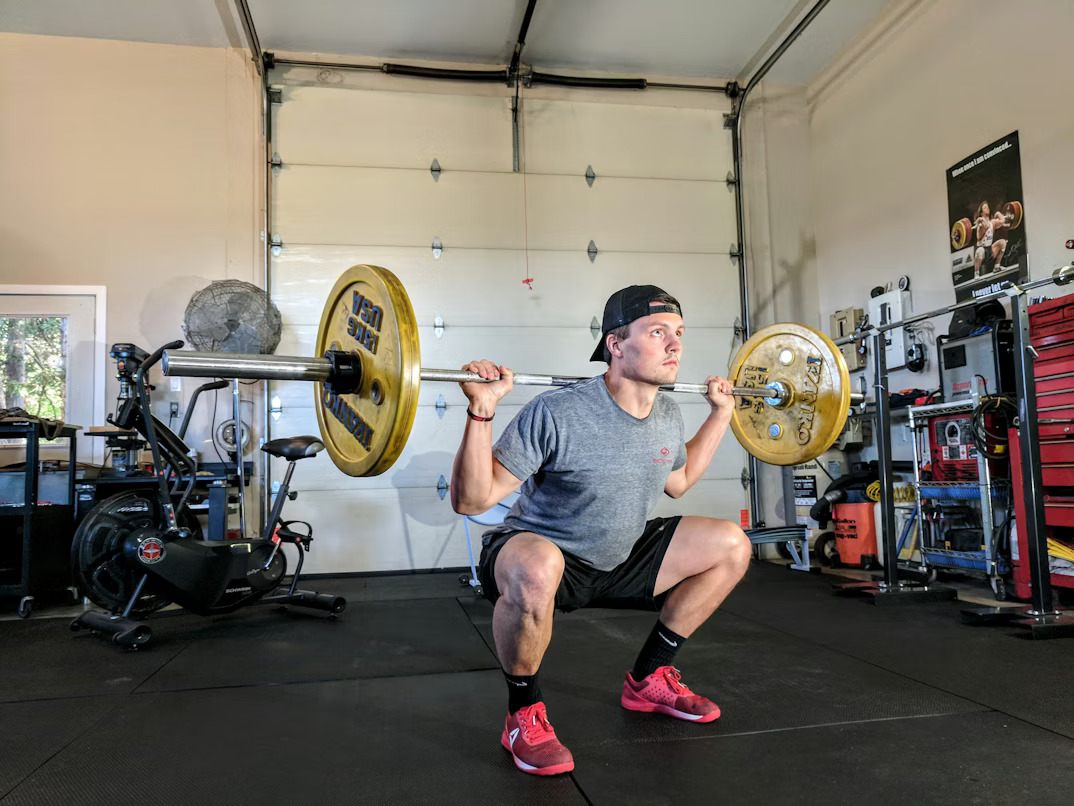
The squat vs leg press question is less about finding one winner and more about choosing the right tool for your body, goals, and current training phase. Squats train a demanding whole-body pattern. The leg press lets you load the lower body with more external support. Used well, both can build strong legs.
Quick Take
- Squats usually carry over better to athletic movement, balance, and everyday lower-body strength.
- The leg press is useful for adding quad-focused volume with less technical demand and less direct spinal loading.
- Neither exercise is automatically safer; setup, range of motion, load, and individual injury history matter.
- For most lifters, the best answer is not squat vs leg press. It is squats for skill and strength, plus leg press for targeted volume.
Squat vs Leg Press: The Main Difference
The squat is a free-weight movement pattern. You support the load, control your torso, manage balance, and coordinate the ankles, knees, hips, trunk, and upper back. That makes it highly valuable, but also more sensitive to technique, mobility, fatigue, and bracing.
The leg press is a machine-supported lower-body exercise. Your torso is braced against a pad while your feet push against a platform. It still involves the hips and knees, but the machine reduces the need to balance the load. That lets many people train their quads and glutes hard without the same skill requirement as a barbell squat.
Research comparing squat and leg press variations shows that muscle activity and joint loading depend heavily on the equipment, depth, stance, and loading method. One flywheel study found similar quadriceps activity between squat and leg press conditions, while knee joint demands differed between the movements. That is a useful reminder: exercise selection is not just about the name of the lift, but how you perform it. comparison of joint and muscle biomechanics
Which Builds More Functional Strength?
For transferable strength, squats usually have the edge. Standing up with a load requires balance, trunk stiffness, hip control, knee tracking, and foot pressure. Those qualities matter in sports, lifting objects, climbing stairs, and getting up from low positions.
That does not make the leg press useless for real-world strength. Stronger quads and glutes still help. The limitation is that the leg press removes much of the balance and torso-control challenge. If you only leg press, you may build strong legs without practicing how to express that strength while standing and stabilizing your own body.
If you are a beginner, returning after a break, or training after 40, this distinction matters. You do not need to rush into heavy barbell squats. Start with a squat variation you can control: bodyweight squats, box squats, goblet squats, or split squats. BeeFit’s guide to longevity strength after 40 explains why basic movement patterns are often more important than chasing maximal loads.
Squat vs Leg Press for Quad Growth
For quad-focused hypertrophy, the leg press is often easier to program. Because your torso is supported, your set is less likely to end because your upper back, balance, or bracing failed first. You can take the quads close to fatigue with a stable path and repeatable form.
Squats can still build excellent quad size, especially when performed with enough depth, control, and knee travel for your anatomy. Front squats, high-bar squats, heel-elevated squats, and controlled tempo squats can all shift more work toward the quads. But squats distribute stress across more systems, including the glutes, adductors, spinal erectors, and trunk.
Muscle growth comes from progressive training, sufficient effort, adequate volume, recovery, and nutrition. A systematic review on resistance training volume supports the importance of weekly set volume for hypertrophy. However, more is not always better once recovery becomes the limiting factor. dose-response relationship between weekly resistance training volume and muscle mass
In practical squat vs leg press programming, that often means squatting first for skill and strength, then using the leg press to add lower-body volume without turning every set into a full-body event. For broader hypertrophy principles, BeeFit’s muscle building fundamentals guide covers progressive overload, recovery, and exercise selection in more detail.
Which Is Easier on the Lower Back?
The leg press often feels more back-friendly because the torso is supported and the load is not resting on the shoulders. For someone who cannot currently tolerate axial loading, that can be valuable. It allows lower-body training while reducing the need for heavy spinal bracing.
Still, the leg press is not automatically safe for every back. Letting the pelvis tuck hard at the bottom, using an excessive range of motion, or lifting the hips off the pad can irritate the lumbar spine. Heavy partial reps with poor control can also shift stress to the knees and hips.
Squats are not automatically dangerous either. A well-coached squat with a neutral, braced trunk can be a productive strength exercise for healthy lifters. A biomechanical review of the squat notes that trunk position, spinal control, depth, and technique choices influence loading and clinical relevance. biomechanical review of the squat exercise
If you have current back pain, radiating symptoms, a recent injury, or a diagnosed spine condition, do not use an article to clear yourself for heavy squats or heavy leg press. Work with a qualified clinician or coach who can assess your symptoms, tolerance, and technique.
What If You Cannot Squat Well Yet?
Poor squat mobility is a valid reason to modify the movement, not a reason to force depth under a heavy bar. Limited ankle dorsiflexion, hip restriction, poor trunk control, or discomfort at the bottom position can all make squats look and feel worse than they need to.
The leg press can help you keep training your legs while you improve the squat pattern separately. Adjust the seat and foot position so you can use a controlled, pain-free range of motion. Keep your feet flat, knees tracking with your toes, and pelvis stable against the pad.
At the same time, practice squat-specific mobility and skill. Goblet squats, box squats, heel-elevated squats, tempo reps, and paused bodyweight squats can improve control without forcing a maximal load. If depth is your main issue, BeeFit’s squat mobility tips are a better long-term fix than avoiding the pattern forever.
How to Program Both Exercises
For most people, the best squat vs leg press plan uses both exercises with different jobs. Put the more technical lift first, then use the more stable lift for additional volume.
A simple strength-and-muscle lower-body session could look like this:
- Squat variation: 3–5 sets of 3–8 reps, leaving one to three good reps in reserve.
- Leg press: 2–4 sets of 8–15 reps with controlled depth and steady tempo.
- Hip hinge: Romanian deadlift, hip thrust, or back extension for 2–4 sets.
- Accessory work: leg curls, calf raises, or single-leg work as needed.
If your priority is maximal strength, give squats more focus and keep leg press volume moderate. If your priority is quad size with less joint or back irritation, reduce squat loading and use the leg press as your main high-effort movement. ACSM’s resistance training guidance emphasizes that exercise prescription should match the person’s goal, ability, experience, and recovery capacity. ACSM resistance training guidelines
Rep ranges should also match the goal. Heavy sets can build strength, moderate and higher-rep sets can build muscle, and both can coexist in the same program. For a deeper breakdown, see BeeFit’s guide to rep ranges for strength and muscle.
FAQ
Will the leg press improve my squat?
It can help indirectly by strengthening the quads and glutes, but it will not replace squat practice. Squatting requires balance, bracing, bar path control, and confidence under load.
Why can I leg press more than I squat?
The machine provides support, changes leverage, and removes much of the balance requirement. The numbers are not directly comparable, so do not use your leg press load to estimate your squat strength.
Are hack squats a good middle ground?
Yes, for many lifters. Hack squats provide a guided path and more support than a free-weight squat, while still feeling more squat-like than a leg press. They can be a strong option for quad-focused training.
The Practical Verdict
If you want better movement skill, athletic carryover, and whole-body strength, keep a squat variation in your program. If you want more quad volume, a stable way to train hard, or a lower-body option when heavy squats are not appropriate, use the leg press.
The smartest squat vs leg press answer is flexible. Choose the version you can perform well, progress gradually, and recover from consistently. Strong legs are built by matching the exercise to the lifter, not by defending one machine or movement forever.
This article is for informational purposes only and is not a substitute for professional medical advice, diagnosis, treatment, or individualized coaching. Always consult a qualified health professional before beginning a new exercise program, especially if you have pain, injuries, or medical conditions.
Discover more from BeeFit: Fitness & Wellness
Subscribe to get the latest posts sent to your email.
Share :