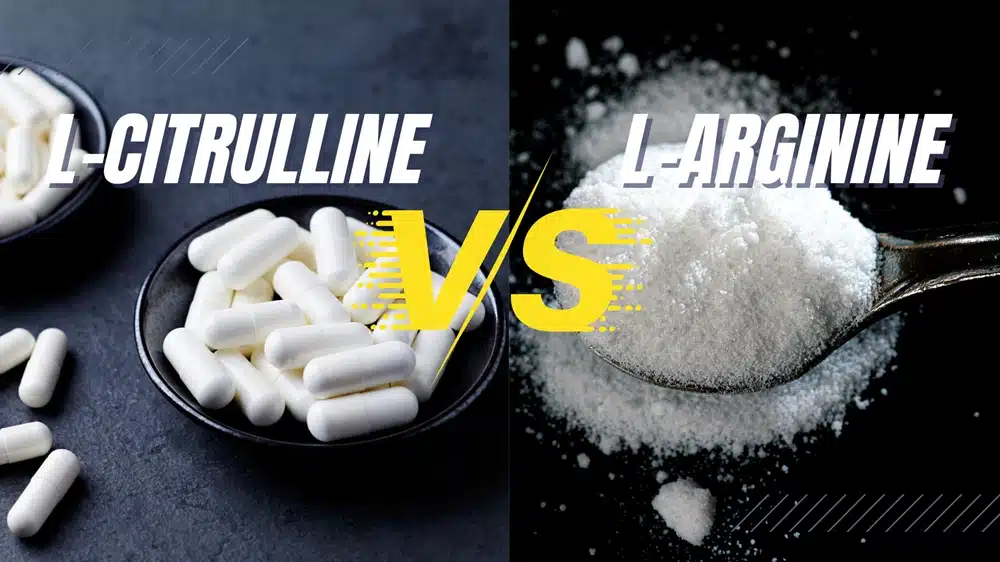
L-citrulline vs L-arginine is one of the most common debates in pre-workout supplements. Both are connected to nitric oxide production, blood flow, and exercise performance, but they do not work the same way in the body.
Quick Take
- L-citrulline is usually the better choice for raising blood arginine levels because it bypasses much of the breakdown that limits oral L-arginine.
- L-arginine still matters biologically, but standalone arginine supplements are less reliable for workout performance in many healthy adults.
- Citrulline may support training volume, perceived effort, blood flow, and post-workout soreness, but it is not a magic pump supplement.
- Common performance dosing is 6–8 grams of citrulline malate 30–60 minutes before training, depending on tolerance and product quality.
- L-arginine may still appear in supplement stacks, but it should not be the main nitric oxide ingredient if performance is the goal.
- Anyone using blood pressure medication, nitrates, ED medication, or heart-related medication should speak with a clinician before using nitric oxide boosters.
The goal of a nitric oxide booster is simple: support blood flow during training. But the supplement aisle often makes L-citrulline and L-arginine sound interchangeable.
They are not. L-arginine is the direct precursor to nitric oxide, but oral arginine can be broken down before much of it reaches circulation. L-citrulline takes an indirect route: it is converted into arginine after absorption, which may raise blood arginine more effectively. A pharmacokinetic study found that oral L-citrulline raised plasma L-arginine and nitric-oxide-related signaling in a dose-dependent way: L-citrulline and nitric oxide metabolism.
This guide explains L-citrulline vs L-arginine for performance, pumps, soreness, dosing, and safety.
1. Why L-Citrulline vs L-Arginine Favors Citrulline for Absorption
L-citrulline is often more effective at raising blood arginine because it avoids much of the intestinal and liver breakdown that limits oral L-arginine. Citrulline is efficiently converted to arginine in the kidneys, leading to higher and more sustained blood arginine levels, which directly boosts nitric oxide production.
When you consume L-arginine directly, enzymes in the intestines and liver (arginase) break down a significant portion before it enters circulation. L-citrulline takes an indirect but superior route. It is converted to L-arginine in the kidneys, circumventing this breakdown, resulting in a more pronounced and longer-lasting increase in plasma arginine.
A pivotal study in the British Journal of Clinical Pharmacology concluded that “L-citrulline supplementation increased plasma L-arginine concentration and improved NO-dependent vasodilation more effectively than L-arginine supplementation itself.”
This does not make L-arginine useless, but it helps explain why L-citrulline is often the more reliable choice for performance-focused nitric oxide support.
Your Application
For reliable nitric oxide boosting, prioritize L-citrulline or citrulline malate. The standard effective dose is 6-8 grams, taken 30-60 minutes before training.
2. Can L-Citrulline Improve Workout Performance?
Possibly. Some studies show citrulline malate may improve repetitions to failure and reduce soreness, while other research is more mixed. The best evidence is stronger for small performance or fatigue benefits than for dramatic strength gains.
The benefits extend beyond vascularity. By enhancing blood flow and aiding in the removal of exercise byproducts like ammonia and lactate, citrulline directly combats muscular fatigue. This allows you to maintain performance for longer during a session.
One Journal of Strength and Conditioning Research study reported more bench-press repetitions and less soreness after citrulline malate, but it should be treated as one study, not a guaranteed result for everyone: citrulline malate and resistance exercise study.
This translates to concrete gains. More volume over time is a primary driver of muscle growth.
Your Application
To maximize strength and hypertrophy sessions, use citrulline malate as a staple in your pre-workout nutrition. Track your sets and reps; you should notice an ability to maintain performance deeper into your workout.
3. Is L-Arginine Useful for Fitness?
Not useless, but usually less reliable than citrulline for performance-focused nitric oxide support. Its role is better suited for specific health applications or as a secondary component in a comprehensive nitric oxide-supporting stack.
While direct arginine supplementation’s bioavailability is poor, it still has physiological roles. Some research supports its use for endothelial function and certain cardiovascular conditions. In fitness, its effects are highly variable person-to-person, and the doses required for a reliable effect are often high and may cause gastrointestinal discomfort.
Standalone arginine may not reliably improve pumps or endurance in healthy lifters, especially compared with citrulline-based products.
Your Application
If you choose to use arginine, do so with managed expectations. It may be found in combination products, but ensure citrulline is the primary NO-boosting ingredient. For non-exercise benefits like general vascular health, consult with a healthcare professional for appropriate dosing.
4. How to Take L-Citrulline Before Workouts
For performance, take 6-8 grams of citrulline malate 30-60 minutes before exercise. Pairing it with carbohydrates can enhance uptake, and combining it with other evidence-based supplements like creatine and beta-alanine creates a powerful synergistic pre-workout stack.
Citrulline malate is the most researched form. Citrulline malate is commonly used in pre-workout studies and products, but formulas vary. Check whether the label lists true L-citrulline content or a citrulline-malate blend. The pre-workout timing ensures peak blood arginine levels coincide with your training session. Stacking is effective because each supplement works through a different, complementary mechanism.
Optimizing your supplement regimen is key to cost-effectiveness and results.
Your Application
Build a foundational pre-workout stack of:
- Citrulline Malate (6-8g): For blood flow and fatigue reduction.
- Creatine Monohydrate (5g): For strength and power output.
- Beta-Alanine (3-5g): For muscular endurance against burning.
This stack is more evidence-based than many proprietary blends, but dose accuracy and third-party testing still matter because FDA does not test dietary supplements before they are sold: FDA dietary supplement Q&A.
L-Citrulline vs L-Arginine FAQ
Q: Can I get enough from food, or do I need a supplement?
A: While foods like watermelon (citrulline) and spinach/beets (nitrates) support NO production, the doses required for a measurable performance effect are very high. For example, you’d need to eat about 4-6 cups of diced watermelon to get 6 grams of citrulline. Supplementation provides a reliable, concentrated dose.
Q: Are there any side effects to taking L-citrulline?
A: L-citrulline is generally very well-tolerated. High doses (above 10g) may cause mild gastrointestinal upset in some individuals, which is why starting at the 6-8g range is recommended. It does not typically cause the stomach discomfort sometimes associated with high-dose L-arginine.
Q: Should I cycle L-citrulline?
A: There is no evidence that the body builds a tolerance to L-citrulline, so cycling is not necessary. It can be taken consistently on training days. As with any supplement, it’s prudent to periodically assess if it’s still providing a noticeable benefit to your training.
Q: Does nitric oxide boosting lower blood pressure?
A: Nitric-oxide-related supplements may lower blood pressure in some people. A meta-analysis found L-arginine and L-citrulline can affect blood pressure, but results vary by population and dose: arginine, citrulline, and blood pressure review. If you take blood pressure medication, nitrates, ED medication, or heart-related medication, ask a clinician before using them. However, individuals with clinically low blood pressure or those taking blood pressure medication should consult a doctor before using NO-boosting supplements.
Bottom Line: L-Citrulline vs L-Arginine for Performance
For most healthy lifters choosing between L-citrulline vs L-arginine, citrulline is usually the better first choice for pre-workout performance support. Its superior pharmacokinetics translate to tangible, research-backed benefits where it matters most: in the gym, enabling more work and faster recovery. L-arginine, while important for health, fails to deliver consistent performance enhancements on its own.
By choosing citrulline malate and dosing it correctly, you’re not just buying into a trend—you’re applying a direct piece of exercise science to overcome a specific limit: muscular fatigue. This is how supplements move from hype to genuine tools for progress.
For more support, read our BeeFit guides on:
- Supplements That Actually Matter
- Protein for Muscle Growth
- Muscle Building Fundamentals
- Build Muscle Without Injury
- And the BeeFit AI Calculator
This article is for informational purposes only and is not a substitute for professional medical advice, diagnosis, or treatment. Always consult your physician or a qualified healthcare provider before starting any new supplement, especially if you have a pre-existing health condition or are taking medication.
Discover more from BeeFit: Fitness & Wellness
Subscribe to get the latest posts sent to your email.
Share :