You can train less and get stronger by focusing on quality repetitions, progressive overload, and recovery instead of making every workout exhausting. Strength requires effort, but more fatigue does not automatically produce better results.
Quick Take
- Strength improves through repeated practice and progressive loading.
- Training to failure is optional, not essential.
- Keep foundational exercises long enough to measure progress.
- Machines and free weights can both build strength.
- A shorter program often works better when you can repeat it consistently.
How to Train Less and Get Stronger
Strength is partly a skill. Repeating an exercise helps your nervous system coordinate the movement, recruit muscle, and produce force more efficiently.
This is the idea behind frequent submaximal practice, sometimes called “Greasing the Groove.” Instead of performing one exhausting workout, you complete easier sets more often while keeping every repetition controlled.
For example, someone who can perform 10 pull-ups might complete several sets of three or four across the week rather than repeatedly testing the maximum.
This method can improve movement-specific strength, but it should not replace a balanced program. Frequent practice works best with one or two familiar exercises and should be reduced if joint discomfort or declining performance appears.
Keep Every Set Repeatable
Use a resistance or repetition target that feels challenging but does not slow your technique. Stop while you could still perform a few clean repetitions.
To train less and get stronger, accumulate useful practice instead of fatigue for its own sake.
Can You Train Less and Get Stronger Without Failure?
Training to failure means continuing until another complete repetition is no longer possible. It can stimulate muscle growth, but it also creates more fatigue and may require additional recovery.
A systematic review of failure training found no clear overall advantage for reaching failure when strength and muscle growth were compared with non-failure training.
For strength-focused exercises such as squats, deadlifts, presses, and rows, stopping with one to three repetitions in reserve is usually enough to create progress while protecting technique.
Failure can still be used selectively on safer exercises, such as curls, lateral raises, or machine movements. It does not need to be used during every set or workout.
Build Strength Without Excess Fatigue
A productive set should feel demanding, but the final repetition should still resemble the first. Stop when:
- Your range of motion shortens
- Your position changes significantly
- You lose control of the weight
- Joint discomfort appears
Progress should be measured through resistance, repetitions, technique, and consistency—not how exhausted you feel afterward.
Exercise Consistency for Better Strength Gains
Constantly changing exercises makes progress difficult to measure. If you want to improve a squat, press, pull, or hinge, you need enough consistent practice to develop the movement.
However, this does not mean performing the same exercises forever. A review of exercise variation found that planned changes may support strength and muscle development, while excessive random variation can interfere with progress.
Build your routine around a few movement patterns:
- Squat or knee-dominant exercise
- Hip hinge
- Upper-body push
- Upper-body pull
- Core or loaded carry
Keep these patterns stable while adjusting the specific exercise when your goals, equipment, comfort, or mobility change.
For example, you might replace a back squat with a goblet squat while keeping the same fundamental movement pattern.
BeeFit’s Muscle Building Fundamentals explains how progressive overload and recovery work together.
Machines and Free Weights for Building Strength
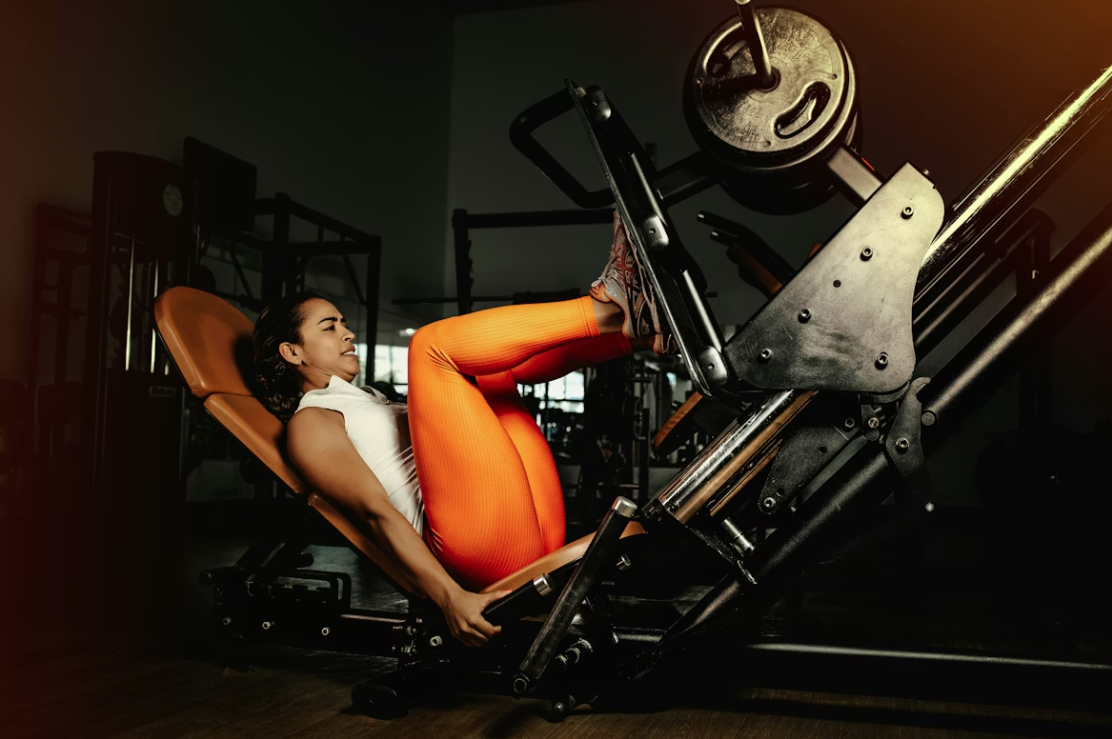
Free weights require greater control of the load, while machines provide a more stable movement path. Neither option is automatically better for every person.
A meta-analysis comparing machines and free weights found similar muscle-growth outcomes. Strength gains were specific to the equipment used: free-weight training improved free-weight performance, while machine training improved machine-based strength.
Free weights may be useful for developing coordination and practicing barbell or dumbbell lifts. Machines can make it easier to train a muscle without balance becoming the limiting factor.
Beginners can use either. The best choice depends on the goal, available equipment, comfort, and whether qualified instruction is available.
Choose Equipment That Helps You Progress
Use free weights when you want to improve:
- Barbell or dumbbell skills
- Balance and load control
- Strength in free-moving exercises
Use machines when you want to:
- Reduce coordination demands
- Train without a spotter
- Add volume with less overall fatigue
- Work around certain mobility limitations
Many effective programs combine both.
Train Less, Get Stronger FAQ
Can I Build Muscle Without Training to Failure?
Yes. Muscle can grow when sets are challenging and weekly training volume is sufficient.
You should generally finish close enough to failure that the set requires real effort, but complete failure is not necessary during every exercise.
How Long Should a Strength Workout Be?
A focused session of approximately 30–60 minutes can be effective. Four or five well-chosen exercises are often enough to train the major muscle groups.
Longer workouts are useful only when the additional work supports your goal and does not interfere with recovery.
How Often Should I Change My Exercises?
Keep important exercises long enough to measure progress, often for several weeks or months. Change them when:
- Progress has stalled
- Pain or discomfort develops
- Equipment changes
- Your goal changes
- The exercise no longer fits your needs
Do not change the program simply because you are no longer sore.
Train Less and Get Stronger With Precision
The idea that you can train less and get stronger does not mean avoiding effort. It means removing work that creates fatigue without producing a clear benefit.
Practice important movements consistently, stop most sets before complete failure, use planned rather than random variation, and choose equipment that matches your goals.
The best program is not the one that leaves you the most exhausted. It is the one you can recover from, repeat, and gradually improve.
For a complete framework, explore BeeFit’s Strength Training After 40 guide or create a starting routine with the BeeFit AI Fitness Planner.
Related BeeFit Guides
This article is for informational and educational purposes only and is not a substitute for medical advice or individualized coaching. Consult a qualified healthcare professional or strength coach before beginning a new training program, particularly if you have an injury, pain, or medical condition.
Discover more from BeeFit: Fitness & Wellness
Subscribe to get the latest posts sent to your email.
Share :