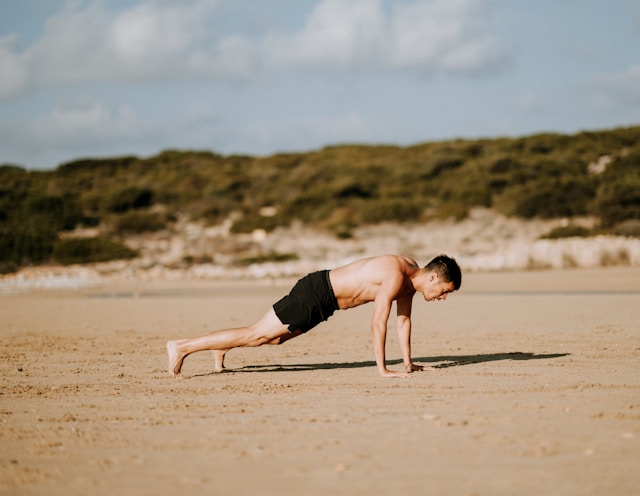
Calisthenics for beginners is one of the simplest ways to start strength training. You use your own bodyweight to build strength, control, mobility, and confidence without needing a gym membership or complicated equipment.
Quick Take
- Calisthenics uses bodyweight exercises such as push-ups, squats, lunges, planks, rows, and pull-up progressions.
- Beginners should focus on movement quality before chasing advanced skills like handstands or muscle-ups.
- Calisthenics can build strength and muscle when you use progressive overload.
- Progression comes from harder variations, more reps, slower tempo, longer holds, better range of motion, and shorter rest.
- The best beginner plan trains the whole body 2–3 times per week.
- Pulling exercises matter. A routine with only push-ups, squats, and planks is incomplete.
- Calisthenics works best when it is simple, repeatable, and progressed slowly.
For many people, the hardest part of fitness is not effort. It is access.
A gym may be expensive, intimidating, crowded, or simply inconvenient. That is where calisthenics shines. You can train at home, in a park, in a hotel room, or anywhere you have enough space to move.
But calisthenics is not magic. It still follows the same rules as other resistance training: your muscles need enough challenge, enough recovery, and a clear progression path.
This guide explains how calisthenics for beginners works, which exercises matter most, how to progress safely, and how to build a simple weekly plan.
What Is Calisthenics for Beginners?
Calisthenics is bodyweight strength training. Instead of using dumbbells, barbells, or machines, you use your own body as resistance.
Common calisthenics exercises include:
| Movement | Beginner version | Harder version |
|---|---|---|
| Push | Wall push-up | Full push-up |
| Squat | Box squat | Split squat |
| Pull | Band pull-apart | Inverted row |
| Core | Dead bug | Plank |
| Hinge | Glute bridge | Single-leg bridge |
| Carry/control | Bear crawl hold | Crawling variations |
The goal is not to jump straight into advanced moves. The goal is to master basic patterns first.
The U.S. Physical Activity Guidelines recommend that adults do muscle-strengthening activities involving all major muscle groups at least 2 days per week: Physical Activity Guidelines.
Calisthenics can help fill that role when it trains the whole body with enough effort and progression.
Is Calisthenics for Beginners Effective for Strength?
Yes, calisthenics can build strength and muscle, especially for beginners and people returning to training.
The key is progressive overload.
That means your body must gradually face a bigger challenge over time. With weights, you usually add more load. With calisthenics, you can progress in several ways:
- Add reps
- Add sets
- Slow down the lowering phase
- Use a harder variation
- Increase range of motion
- Shorten rest periods
- Add pauses
- Improve control
- Move from two-limb to single-limb variations
For example, a push-up progression might look like this:
| Level | Exercise |
|---|---|
| 1 | Wall push-up |
| 2 | Incline push-up |
| 3 | Knee push-up |
| 4 | Full push-up |
| 5 | Deficit push-up |
| 6 | Feet-elevated push-up |
| 7 | Archer push-up |
A 2017 study on untrained men found that an 8-week calisthenics program improved push-up performance, pull-up performance, posture measures, and body composition compared with a control group: calisthenics training study.
That does not mean calisthenics is automatically better than free weights or machines. It means bodyweight training can work when it is structured well.
The BeeFit rule is simple:
Calisthenics is not “easy training.” It is resistance training with your own bodyweight.
Who Is Calisthenics for Beginners Best For?
Calisthenics for beginners is a strong fit if you want a low-cost, low-barrier way to start training.
It works especially well for:
- Beginners
- Home exercisers
- Travelers
- Busy adults
- People intimidated by gyms
- People rebuilding consistency
- Anyone who wants better body control
- People who want a simple starting point before using weights
It may be less ideal as your only training method if your main goal is maximum muscle size or heavy strength development. At some point, weights and machines can make progressive overload easier to measure.
But for starting, rebuilding, or staying consistent, calisthenics is excellent.
It teaches you how to move your body before you worry about moving heavy weight.
Best Calisthenics Exercises for Beginners
A good beginner plan should train five movement patterns:
- Push
- Pull
- Squat
- Hinge
- Core
Push Exercises
Push exercises train the chest, shoulders, and triceps.
Best options:
| Level | Exercise |
|---|---|
| Beginner | Wall push-up |
| Beginner+ | Incline push-up |
| Intermediate | Knee push-up |
| Intermediate+ | Full push-up |
| Advanced | Feet-elevated push-up |
Form cues:
- Keep your body in one straight line.
- Do not let the hips sag.
- Keep elbows around 30–45 degrees from the body.
- Lower with control.
- Stop the set before form breaks.
Pull Exercises
Pulling is the missing piece in many bodyweight routines.
Push-ups are easy to do at home, but pulling requires a little creativity. You can use a sturdy table, suspension trainer, resistance band, door anchor, or pull-up bar.
Best options:
| Level | Exercise |
|---|---|
| Beginner | Band pull-apart |
| Beginner+ | Towel row variation |
| Intermediate | Inverted row |
| Intermediate+ | Assisted pull-up |
| Advanced | Pull-up |
Pulling exercises help train the back, biceps, rear shoulders, and posture muscles. They also balance all the pushing work.
If you cannot do a pull-up, do not worry. Start with rows and assisted variations.
Squat Exercises
Squats train the quads, glutes, hips, and core.
Best options:
| Level | Exercise |
|---|---|
| Beginner | Sit-to-stand |
| Beginner+ | Box squat |
| Intermediate | Bodyweight squat |
| Intermediate+ | Split squat |
| Advanced | Assisted pistol squat |
Form cues:
- Keep feet planted.
- Use a range of motion you can control.
- Let knees track in the same direction as toes.
- Keep your torso stable.
- Do not force depth if your hips, ankles, or knees are not ready.
Hinge Exercises
The hinge pattern trains the glutes, hamstrings, and lower-body control.
Best options:
| Level | Exercise |
|---|---|
| Beginner | Glute bridge |
| Beginner+ | Hip hinge drill |
| Intermediate | Single-leg glute bridge |
| Intermediate+ | Bodyweight good morning |
| Advanced | Single-leg Romanian deadlift |
Many beginners skip hinge work, but it matters for hip strength and back-friendly movement.
Core Exercises
Core training is not just about crunches. A strong beginner plan should teach your trunk to resist movement.
Best options:
| Goal | Exercise |
|---|---|
| Anti-extension | Plank |
| Core control | Dead bug |
| Side stability | Side plank |
| Anti-rotation | Pallof press with band |
| Hollow strength | Hollow body hold |
Start with control, not duration. A clean 20-second plank is better than a messy 90-second plank.
Calisthenics for Beginners Workout Plan
Start with 2–3 full-body sessions per week.
Leave at least one rest day between sessions if you are new.
Beginner Workout A
| Exercise | Sets | Reps |
|---|---|---|
| Incline push-up | 3 | 6–10 |
| Box squat | 3 | 8–12 |
| Band pull-apart or inverted row | 3 | 8–12 |
| Glute bridge | 3 | 10–15 |
| Dead bug | 2 | 8–10 each side |
Beginner Workout B
| Exercise | Sets | Reps |
|---|---|---|
| Knee push-up or full push-up | 3 | 5–10 |
| Split squat or reverse lunge | 2–3 | 6–10 each side |
| Inverted row or assisted pull-up | 3 | 6–10 |
| Side plank | 2 | 20–30 sec each side |
| Glute bridge march | 2–3 | 8–10 each side |
Weekly Schedule
| Day | Plan |
|---|---|
| Monday | Workout A |
| Tuesday | Walk or mobility |
| Wednesday | Workout B |
| Thursday | Rest or easy cardio |
| Friday | Workout A |
| Saturday | Walk, bike, hike, or mobility |
| Sunday | Rest |
The next week, start with Workout B.
This gives your body repeated practice without overwhelming recovery.
How Beginners Should Progress Calisthenics Safely
Progress slowly. Your muscles may adapt faster than your wrists, shoulders, elbows, knees, and tendons.
Use this rule:
Move to a harder variation only after you can perform the current version with clean form for the top end of the rep range.
Example:
If your goal is 3 sets of 10 incline push-ups, do not switch to full push-ups until those 3 sets feel controlled.
Progression options:
| If the exercise feels too easy | Try this |
|---|---|
| Reps are too easy | Add 1–2 reps per set |
| Form is clean | Add one set |
| You want more challenge | Slow the lowering phase |
| You need more resistance | Use a harder variation |
| You want better control | Add a pause |
| You feel joint discomfort | Regress the movement |
A smart progression is not always harder.
Sometimes the best progression is cleaner form.
Common Calisthenics for Beginners Mistakes
Mistake 1: Skipping Pulling Exercises
Many beginners do push-ups, squats, and planks but forget rows or pull-up progressions. That can create an unbalanced plan.
Fix it by pairing every push movement with a pull movement.
Mistake 2: Chasing Advanced Skills Too Early
Muscle-ups, handstands, pistol squats, and planches look impressive, but they require strength, mobility, and joint preparation.
Earn the basics first.
Mistake 3: Doing Random Circuits Forever
Sweaty circuits can improve conditioning, but they are not always the best way to build strength.
A better plan tracks exercises, reps, sets, and progressions.
Mistake 4: Ignoring Recovery
Calisthenics still creates training stress. Push-ups, rows, squats, and planks need recovery just like weights do.
If joints hurt, performance drops, or soreness lingers, reduce volume.
Mistake 5: Thinking Bodyweight Means No Progression
Bodyweight training can be progressed. You just need a plan.
More control, harder variations, better range of motion, and higher volume all count.
How Calisthenics Fits With Weights
You do not have to choose between calisthenics and weight training.
They work well together.
| Use calisthenics for | Use weights for |
|---|---|
| Push-ups | Easier load progression |
| Pull-up progressions | Heavy lower-body training |
| Planks and core control | Targeted hypertrophy |
| Mobility and body control | Maximum strength |
| Travel workouts | Precise loading |
| Warm-ups and finishers | Long-term measurable overload |
A smart BeeFit plan might use calisthenics at home and weights in the gym.
For example:
- Push-ups at home
- Rows with dumbbells at the gym
- Squats or lunges anywhere
- Pull-ups at the park
- Machines when joints need support
The best training tool is the one that helps you train consistently and progress safely.
Calisthenics for Beginners FAQ
Can You Build Muscle With Calisthenics?
Yes, especially as a beginner. Muscle growth requires enough resistance, enough effort, enough protein, and progressive overload. Calisthenics can provide that when you use harder variations over time.
Is Calisthenics Better Than Weight Training?
Not necessarily. Calisthenics is more accessible and can improve body control, but weights are often easier to progress precisely. The best choice depends on your goal, equipment, joints, and preference.
How Many Days Per Week Should Beginners Do Calisthenics?
Most beginners do well with 2–3 full-body sessions per week. Add walking or light cardio on other days if recovery feels good.
What If I Cannot Do a Push-Up?
Start with wall push-ups or incline push-ups. Lower the surface over time until you can do push-ups from the floor.
What If I Cannot Do a Pull-Up?
Start with inverted rows, band-assisted rows, dead hangs, scapular hangs, and slow negative pull-ups. Pull-ups take time and are not required on day one.
Do I Need Equipment?
No, but a few simple tools help. A resistance band, pull-up bar, or suspension trainer makes pulling exercises much easier to include.
Is Calisthenics Good After 40?
Yes, as long as you progress gradually and respect joint feedback. Calisthenics can be a strong option for building strength, mobility, and consistency after 40.
Should I Do Calisthenics Every Day?
Not hard sessions every day. You can practice light mobility or easy movement daily, but strength-focused calisthenics should include recovery days.
Bottom Line: Start Simple and Progress Slowly
Calisthenics for beginners works because it removes the biggest excuses. You do not need a gym, complicated machines, or a perfect schedule.
All you need is your body, a few basic movements, and a progression plan you can repeat.
Start with push-ups, rows, squats, glute bridges, planks, and walking. Train 2–3 times per week. Add reps slowly. Move to harder variations only when your form is ready.
The goal is not to master advanced skills overnight.
The goal is to build a stronger, more capable body you can train anywhere.
For more support, read BeeFit’s guides on
- Strength Training After 40
- Strength Training After 40 Rules
- Muscle Building Fundamentals
- Build Muscle Without Injury
- BeeFit AI Calculator
This article is for informational purposes only and is not medical advice. Talk with a qualified healthcare professional before starting a new exercise program, especially if you have chest pain, dizziness, shortness of breath, uncontrolled blood pressure, joint pain, recent injury, pregnancy, osteoporosis, or a medical condition.
Photo: Annie Spratt / Unsplash
Discover more from BeeFit: Fitness & Wellness
Subscribe to get the latest posts sent to your email.
Share :